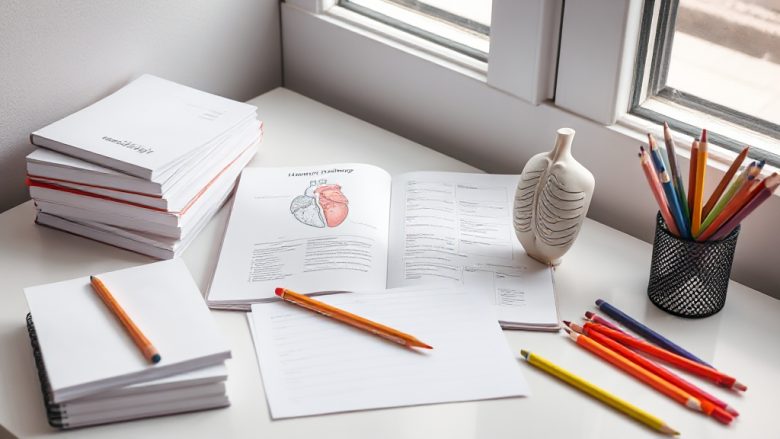
Human biology can feel enormous. Every system connects to another, every term seems to have three more hiding behind it, and the textbooks are heavy enough to double as doorstops. I’ve watched plenty of adult learners open a 900-page anatomy book, read two pages, and quietly close it forever.
The good news is that you don’t need to swallow the whole subject at once. If you want to know how to get started with human biology, the trick isn’t working harder; it’s working in a sensible order. This is the same roadmap I give students who arrive with zero science background and a lot of nervous energy, and it works because it removes decisions. You always know what comes next.
Core topics: what to study first
Start with the vocabulary of the body itself. That means four things: cells, tissues, organs, and systems. Everything else, from a heartbeat to a sneeze, is built on those four levels. Spend your first week here. Learn what a cell membrane does, why cells specialise, and how groups of similar cells form the four basic tissue types: epithelial, connective, muscle, and nervous. If you can explain those four types out loud in your own words, you’re ready to move on.
Next comes the framework: bones and muscles. This surprises people. They expect to start with the heart or the brain, but the musculoskeletal system gives you physical landmarks you can actually feel on your own body. Touch your sternum, find your clavicle, roll your shoulder joint. Anatomy stops being abstract the moment you can point to it. Learn the major bone groups, the difference between the axial and appendicular skeleton, and how a muscle contracts using actin and myosin. That last one sounds technical, but it’s a single mechanism you can sketch in two minutes.
Only then move to the systems most people find fascinating. The cardiovascular system teaches you how blood moves, why pressure matters, and what a heart actually does between beats. The respiratory system pairs naturally with it, since both are about transport. From there, take the nervous system, which is the control centre, and the endocrine system, which is the slower chemical messaging service. Finish with digestion, the urinary system, and reproduction. Notice the order: structure first, then transport, then control, then regulation.
One topic deserves its own place: homeostasis. It’s the idea that the body constantly corrects itself toward a stable internal state. Temperature, blood sugar, pH, water balance. Almost every system you study is really a homeostasis machine wearing a different costume. If you understand that concept early, later chapters stop feeling like a list of unrelated facts.
What about genetics and immunity? They’re valuable, but they’re not where beginners should begin. Genetics makes far more sense once you understand cells and reproduction. Immunology makes far more sense once you understand blood and tissues. Save them for your second pass through the material, not your first.
Study order: how to sequence your learning
The single biggest mistake beginners make is studying systems in isolation. They memorise the heart one month, the lungs the next, and never connect them. A better approach is to follow the body’s own logic.
Begin with a short orientation phase, roughly one to two weeks. Read an introductory chapter or two on the levels of organisation, the language of anatomy (anterior, posterior, proximal, distal), and homeostasis. This phase isn’t about depth. It’s about installing the mental furniture so that everything later has somewhere to sit.
Then move into structure: cells, tissues, skin, bones, joints, muscles. This is your longest early phase, maybe three to four weeks at a relaxed pace. Draw as you go. Label diagrams from memory, not by copying. If you can’t redraw a nephron or a sarcomere without looking, you don’t know it yet, and that’s fine. Nobody does on the first attempt.
After structure comes function. Work through cardiovascular, respiratory, and digestive systems as a connected block, because they are connected. Follow the path of a single red blood cell from the heart to a toe and back. Follow a bite of food from mouth to bloodstream. These narrative journeys do more for retention than any flashcard deck.
Next, control and regulation: nervous and endocrine systems together. This is where many learners hit a wall, because the terminology gets dense. Slow down here. Give yourself permission to spend two weeks on the nervous system alone. Then finish with the urinary and reproductive systems, which tie back neatly to homeostasis and genetics.
Build in review from day one. A simple rhythm works well: study new material for three days, spend the fourth day reviewing only old material, then continue. Spaced repetition isn’t a buzzword; it’s just the observation that your brain forgets on a schedule, and you can beat that schedule by showing up before the forgetting wins.
Finally, set a realistic timeline. A motivated beginner studying a few hours a week can cover the essentials in four to six months. Someone preparing for a formal course might compress that into ten weeks. Neither pace is better. The only wrong pace is the one that makes you quit in week two.
Simple resources and habits that actually help
You don’t need a laboratory or an expensive course to start. You need three things: one reliable textbook, one visual reference, and a way to test yourself.
For the textbook, choose an introductory human biology or anatomy and physiology text aimed at non-specialists. Any well-regarded edition from the last decade will do. Don’t buy five books. One book read properly beats five books skimmed. If you prefer video, look for lecture series that follow a standard syllabus, and watch them alongside your reading rather than instead of it.
For visuals, an anatomy colouring book is genuinely useful, not childish. Colouring forces you to notice structure, and noticing is the first step to remembering. A simple anatomical model or even a printed poster of the major systems on your wall gives you passive exposure every day, which quietly compounds.
For self-testing, keep it low-tech. Write questions on index cards and answer them aloud. Explain the cardiac cycle to an imaginary student. Draw a diagram from a blank page. These methods feel slower than highlighting, and that’s exactly why they work. Highlighting creates the feeling of learning; recall creates the fact of it.
Three habits matter more than any resource. First, study in short sessions of 25 to 40 minutes rather than marathon sittings. Second, connect every new term to something you can feel or picture on your own body. Third, keep a running list of questions you can’t answer yet, and revisit it weekly. That list becomes your personal syllabus.
Be patient with the early confusion. The first month of human biology is mostly vocabulary, and vocabulary always feels like drowning before it feels like swimming. Around week five or six, something clicks: you start predicting how systems behave before you’ve read the chapter. That moment is worth waiting for, and it arrives for almost everyone who follows a sensible order instead of a random one.
Start with cells, then structure, then function, then control. Draw more than you read. Review before you forget. Do that, and the enormous subject shrinks into something you can genuinely hold in your head.